In this article
Why is Ceylon now called Sri Lanka? The island nation in the Indian Ocean has officially borne the name Sri Lanka since 22 May 1972. On that day, the country adopted a new constitution, became a republic and dropped the state name Ceylon inherited from the colonial era. The renaming was intended to give greater expression to the country's political independence and cultural identity.
The name Sri Lanka has historical roots that long predate European colonial rule. Other names, including Serendib, Taprobane and Lanka, also tell the story of the island's eventful past.
Why is Ceylon now called Sri Lanka?
Ceylon was renamed Sri Lanka in 1972 because, with its new republican constitution, the country wanted to replace its colonial-era state name and emphasise its independence.
The renaming was part of a wider political transformation. Although Ceylon had already gained independence from Britain on 4 February 1948, the British monarch initially remained the formal head of state.
This system of government changed fundamentally only with the republican constitution of 22 May 1972.
The main reasons for the name change were:
- Moving away from the colonial legacy: the English name Ceylon recalled European foreign rule.
- Emphasising national independence: the new republic was also to be reflected in its name.
- Returning to historical names: Lanka was known in South Asian traditions long before the colonial era.
- Reshaping the system of government: the 1972 constitution replaced the British monarchy as head of state.
Sri Lanka's official National Archives confirm that the constitution was adopted on 22 May 1972 and that the name Ceylon was replaced by Sri Lanka.
Was Sri Lanka a different country before 1972?
No. Ceylon and Sri Lanka refer to the same island and the same state at different stages in its history.
The name change did not involve any geographical relocation or division of the country.
Colombo, important cultural sites such as Kandy and Anuradhapura and the large tea plantations in the central highlands remained on the same island.
The political system and the country's official name changed, rather than the geographical country itself.
What does the name Sri Lanka mean?
The name Sri Lanka comes from the South Asian linguistic and cultural sphere and consists of two elements.
The meaning of “Sri”
The word Sri comes from Sanskrit and is associated with splendour, beauty, prosperity and dignity.
It also serves as an honorific or respectful prefix for people, deities and places.
The meaning of “Lanka”
Lanka is a historical name known from South Asian literature and religious traditions.
It is often associated with the island of Sri Lanka. In Hindu tradition, particularly the epic Ramayana, Lanka refers to the kingdom of King Ravana.
It has not been conclusively established whether every early literary mention of Lanka refers specifically to the present-day island of Sri Lanka.
How can Sri Lanka be translated?
Sri Lanka is often loosely translated as “resplendent island” or “venerable island”.
These expressions convey its cultural meaning. However, they are not exact, literal translations of every linguistic element.
The Online Etymology Dictionary explains, in particular, the Sanskrit roots of Sri and the older name Lanka.
What was Sri Lanka called before? An overview of its historical names
For centuries, the island was an important trading hub between South Asia, the Middle East and Europe.
Travellers, geographers, merchants and colonial powers used different names. Some of these names existed alongside one another.
| Historical name | Origin or usage | Meaning and background |
|---|---|---|
| Tambapanni | Ancient South Asian traditions | Often associated with copper-coloured earth |
| Taprobane | Ancient Greek and Roman geography | European transmission of an ancient island name |
| Lanka | Sanskrit and South Asian literature | Historical and cultural name for the island |
| Serendib / Serendip | Arabic and Persian traditions | A name from trading and travel accounts |
| Ceilão | Portuguese, from the 16th century | European form of the name |
| Zeylan / Zeilan | Dutch and other European forms | A name used during the era of European trade and colonial rule |
| Ceylon | English; the official state name until 1972 | Spread particularly through British rule |
| Sri Lanka | Since 22 May 1972 | Official name of the republic |
The table shows the main forms of the name, rather than a complete chronological sequence. Some were used at the same time in different languages.
The Tamil name Ilankai (இலங்கை) and historical forms such as Eelam also belong to the island's diverse naming history.
Where does the name Ceylon come from?
The English name Ceylon developed through several intermediate linguistic forms.
It is closely connected with older names traced back to Sinhala or related linguistic forms.
From Sinhala through Ceilão to Ceylon
When Portuguese sailors reached the island in the early 16th century, the name Ceilão came into use in Portuguese.
The Dutch later used forms such as Zeylan and Zeilan.
During British rule, the English spelling Ceylon became established.
In simplified form, the development can be shown as follows:
A simplified history of the name
- Sinhala / related older names – Linguistic roots
- Ceilão – Portuguese form
- Zeylan / Zeilan – Dutch and European variants
- Ceylon – English state name until 1972
This diagram simplifies a linguistic development in which several forms were used in parallel.
The name Ceylon was therefore not invented entirely from scratch by the British. It was an English form of older names that became established during the European colonial period.
What does Serendib mean, and how is it connected to Sri Lanka?
Serendib is a historical Arabic-Persian name for Sri Lanka, probably derived from older South Asian names such as Simhaladvipa.
The element dvipa means “island” in Sanskrit.
Spellings such as Sarandib, Serendib and Serendip appear in different historical sources. These variants reflect different languages and routes of transmission.
Sri Lanka as a trading island in the Indian Ocean
Arab and Persian merchants maintained trading relationships with South Asia for centuries.
Sri Lanka was favourably located along maritime trade routes and was known for gemstones, spices and other goods.
The name Serendib consequently spread beyond the immediate region.
It appears in both geographical texts and literary traditions.
How did the English word “serendipity” originate?
A particularly interesting linguistic connection exists between the old island name Serendip and the English word serendipity.
The British writer Horace Walpole used the term in a letter in 1754, inspired by the story The Three Princes of Serendip.
Today, serendipity describes the ability or good fortune to discover something valuable unexpectedly.
A historical name for Sri Lanka thus lives on in the English language today.
Sri Lanka's colonial history: from Ceilão to Ceylon
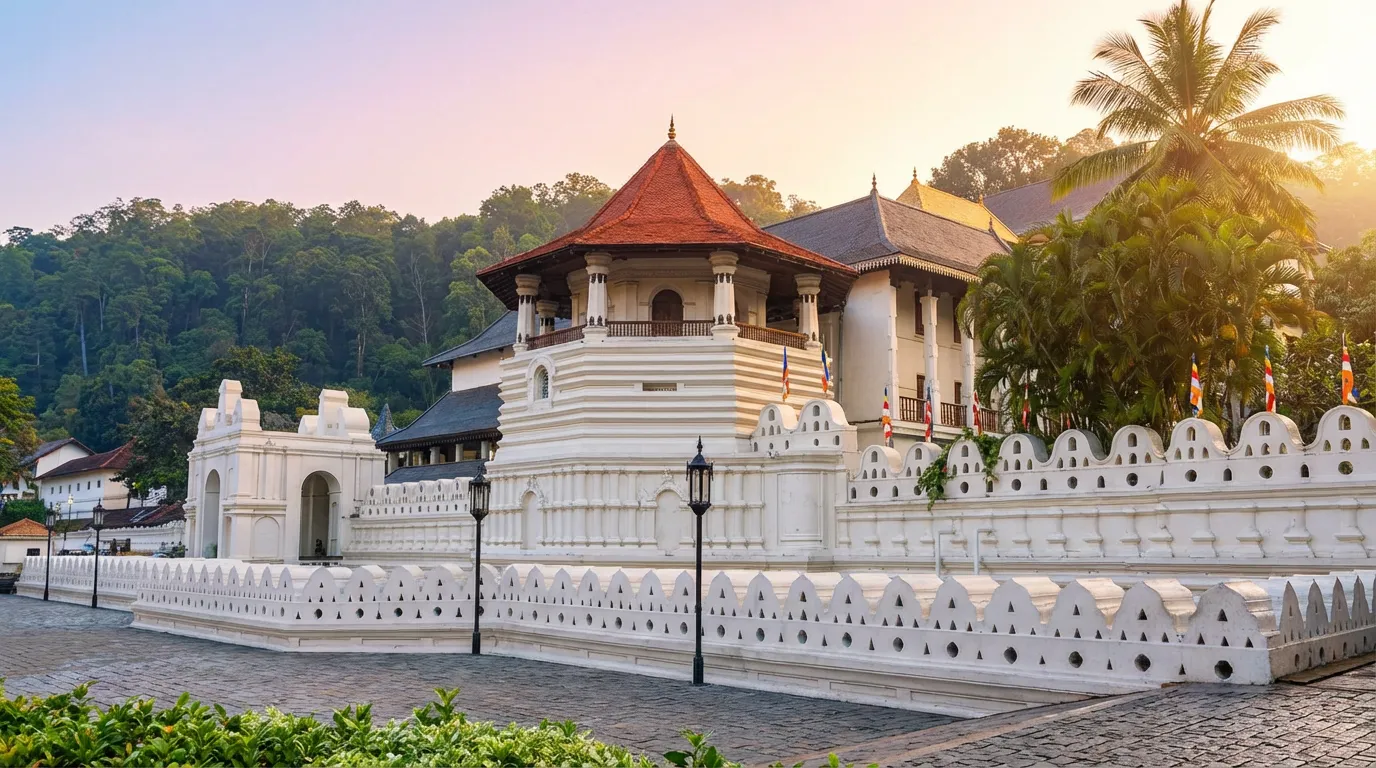
To understand the renaming in 1972, it helps to look at the history of European colonial rule.
One distinction is essential: the Portuguese and Dutch powers mainly controlled the coastal regions. The inland Kingdom of Kandy was able to preserve its independence for longer.
1505–1658: the Portuguese period
The arrival of Portuguese sailors in the early 16th century marked the beginning of a prolonged period of European influence.
The Portuguese expanded their control over important coastal areas and were particularly interested in the spice trade.
Cinnamon was one of the island's economically significant products.
The Portuguese name Ceilão spread during this period.
1658–1796: Dutch rule
The Dutch East India Company drove the Portuguese out of their remaining coastal strongholds.
Fortifications, trading facilities and colonial administrative institutions were further developed under Dutch administration.
Today's Galle Fort is one of the best-known historical reminders of this period.
Variants such as Zeylan and Zeilan appear in Dutch and other European documents.
1796–1948: the British period
In 1796, the British took over Dutch possessions on the island.
In 1815, the end of the independent Kingdom of Kandy finally brought the central highlands under British control as well.
The island was administered under the English name Ceylon.
The economy and infrastructure changed profoundly during the British period. Coffee, tea, rubber and other plantation crops were grown for export.
If you would like to explore the highlands by rail today, you will find practical tips in our guide to the train journey from Kandy to Ella.
The colonial economy also rested on unequal patterns of ownership and the labour of workers, including many plantation workers recruited from South India.
The English name Ceylon became firmly established in international trade, on maps and in official documents.
Key historical events from Ceylon to Sri Lanka
The development into a republic can be traced through several decisive dates.
| Year | Event | Historical significance |
|---|---|---|
| 1505 | Beginning of Portuguese contact | European influence begins |
| 1658 | The Dutch drive out the Portuguese | New colonial administration of the coastal regions |
| 1796 | The British take over Dutch territories | Beginning of British control |
| 1815 | The Kingdom of Kandy loses its independence | British rule extends across the entire island |
| 1948 | Independence on 4 February | Ceylon becomes an independent state |
| 1972 | New constitution on 22 May | Ceylon becomes the Republic of Sri Lanka |
| 1978 | New constitution from 7 September | The state name becomes the Democratic Socialist Republic of Sri Lanka |
Sources: National Archives of Sri Lanka, Ministry of Finance of Sri Lanka and the 1978 constitution.
What happened on 22 May 1972?
22 May 1972 is the decisive date in the history of the renaming.
The first republican constitution came into force on that day.
The political changes were far-reaching.
Sri Lanka became a republic
The new constitution ended the British monarchy's position as head of state.
The former Governor-General, William Gopallawa, became the republic's first president.
The constitution redefined the state and used the name Sri Lanka.
The country had thereby ended its formal link to the British Crown as head of state.
Why did the name change happen 24 years after independence?
At independence on 4 February 1948, Ceylon initially became a self-governing, independent state within the Commonwealth, with the British monarch as head of state.
The state name was retained, as were essential elements of the parliamentary system.
The government led by Prime Minister Sirimavo Bandaranaike later initiated a fundamental constitutional change.
This culminated in the new republic and the official name change in 1972.
The renaming was therefore not an immediate part of independence in 1948, but a second, separate historical step.
Was the renaming politically uncontroversial?
No. The constitutional process of 1972 involved far more than a new state name.
Among other things, the constitution strengthened the position of Buddhism and retained the central role of Sinhala in the state's language arrangements.
These provisions were controversial, particularly in relations between the Sinhalese majority and Tamil minorities.
The renaming is therefore connected with decolonisation, but also with political debates about national identity, language and the rights of different communities.
A historical interpretation should consider both aspects.
Why was Sri Lanka renamed again in 1978?
Sri Lanka adopted another constitution in 1978.
When it came into force on 7 September 1978, the official state name was expanded to the Democratic Socialist Republic of Sri Lanka.
The core name Sri Lanka remained unchanged.
The new constitution also changed the political system and established an executive presidency with expanded powers.
The 1978 designation remains the official long form of the country's name today.
Why is it still called Ceylon tea?
Although the state has been called Sri Lanka since 1972, the name Ceylon remains familiar in international trade.
The most prominent example is Ceylon Tea.
Ceylon tea is a globally recognised designation of origin
The tea industry developed into an important economic sector during British colonial rule.
In 1867, the Scottish planter James Taylor laid the foundations for commercial tea cultivation at Loolecondera near Kandy.
Over the following decades, tea became an important export product.
By the time the country changed its name in 1972, the name Ceylon Tea already enjoyed strong international recognition.
The industry therefore retained it.
According to the Sri Lanka Tea Board, the name was deliberately kept to preserve the product's established reputation on the world market.
Is Ceylon tea the same as Sri Lankan tea?
Geographically, Ceylon tea comes from Sri Lanka.
However, the designation Ceylon Tea is subject to specific origin and quality requirements.
For example, the Sri Lanka Tea Board administers the well-known Lion Logo for pure Ceylon tea grown, processed and packed in Sri Lanka.
A tea containing only a small proportion of Sri Lankan tea cannot automatically be marketed as pure Ceylon tea.
Where else do we encounter the name Ceylon?
The historical name also appears in various product and cultural designations:
- Ceylon Cinnamon: a trade name for true Ceylon cinnamon, botanically known as Cinnamomum verum.
- Ceylon Sapphire: a common designation of origin for sapphires from Sri Lanka.
- Ceylon Tea: the international name for tea from Sri Lanka.
- Historical buildings and institutions: the old country name continues to appear in various proper names.
The former state name has therefore not disappeared entirely from international usage.
Ceylon or Sri Lanka: which is correct today?
Both terms are historically understandable, but they are used in different contexts.
| Term | Present-day usage | Example |
|---|---|---|
| Sri Lanka | Official short form of the country's name | “We are travelling to Sri Lanka.” |
| Democratic Socialist Republic of Sri Lanka | Official full state name | Official documents |
| Ceylon | Historical name for the country | “Ceylon gained independence in 1948.” |
| Ceylon tea | Product name and designation of origin | “Ceylon tea from Nuwara Eliya” |
| Serendib | Historical and literary name | “Arab merchants knew the island as Serendib.” |
Sri Lanka is the correct name to use when referring to the country today.
For historical events before 1972, Ceylon remains an appropriate name, provided it fits the period in question.
Frequently asked questions about the renaming of Ceylon
When was Ceylon renamed Sri Lanka?
Ceylon was officially renamed Sri Lanka on 22 May 1972. On that day, the republican constitution came into force, making the country a republic and replacing its former state name, Ceylon.
Why was Ceylon renamed?
The renaming of Ceylon to Sri Lanka was part of the political move away from the British colonial legacy. With its new name, the republic wanted to emphasise its independence and historical cultural roots.
Who renamed Ceylon Sri Lanka?
The renaming took place through the republican constitution of 1972 under the government of Prime Minister Sirimavo Bandaranaike. It was a constitutional decision of the state, rather than the decision of a single person.
What was Sri Lanka called before Ceylon?
Before the English name Ceylon, various names were used, including Ceilão, Zeylan, Serendib, Taprobane and Lanka. These names come from different languages and historical periods.
What does Ceylon mean in German?
Ceylon has no commonly used separate German translation. The name developed from older island names through Portuguese and other European forms into the English spelling Ceylon.
What does Serendib mean?
Serendib is a historical Arabic-Persian name for Sri Lanka. It is often derived from older forms such as Simhaladvipa. The name is also connected with the origin of the English word serendipity.
When did Sri Lanka gain independence?
Sri Lanka gained independence from Britain as Ceylon on 4 February 1948. The British monarchy initially remained the formal head of state. The country became a republic only in 1972.
Why is Sri Lanka also called the Teardrop Island?
Sri Lanka is sometimes called the Teardrop Island because its shape on maps resembles a drop of water or a tear. This is a figurative nickname, rather than an official country name.
Is Ceylon the same as Sri Lanka?
Yes. Ceylon is the former English state name of present-day Sri Lanka. The island was officially renamed in 1972. Geographically, it is the same country in the Indian Ocean, southeast of India.
What is the capital of Sri Lanka?
Sri Jayawardenepura Kotte is the seat of parliament and is described as the legislative capital. Colombo remains the major economic and commercial centre and the location of numerous state institutions.
Conclusion: why is Ceylon now called Sri Lanka?
The question “Why is Ceylon now called Sri Lanka?” is best answered by looking at the country's political development.
Ceylon was an internationally established name shaped during the European colonial period. After gaining independence from Britain in 1948, the state initially retained it.
On 22 May 1972, Ceylon officially became Sri Lanka. The new republican constitution ended the British monarchy's position as head of state and gave the country a name with older South Asian roots.
The historical names Serendib, Taprobane, Ceilão and Ceylon show how closely the island's history is connected with different trading and cultural spheres.
Today, the country is called Sri Lanka. Its former name, Ceylon, nevertheless lives on in historical documents, cultural designations and internationally recognised products such as Ceylon tea.
Sources and further reading
The historical dates and linguistic explanations in this article draw particularly on the following sources:
1. National Archives of Sri Lanka: Becoming a Republic. Official account of the republican constitution and the renaming on 22 May 1972.
2. Parliament of Sri Lanka: Constitution of Sri Lanka (Revised Edition 2023). Consolidated constitutional text published by the Parliament Secretariat; amendments through 31 October 2022 (unofficial edition).
3. Ministry of Finance, Sri Lanka: Economic Phases: Towards an Open Economy. Historical overview of the constitutional change in 1978.
4. Online Etymology Dictionary: Sri Lanka: Origin and Etymology. Linguistic background on Sri Lanka, Ceylon and serendipity.
5. Sri Lanka Tea Board: Ceylon Tea. Official information on the history and continued use of the name Ceylon Tea.
6. Sri Lanka Tea Board: Why Ceylon Tea?. Explanations of the designation of origin and the international brand value of Ceylon tea.
7. Sri Lanka Tea Board: Ceylon Tea Product Specification (PDF). Documentation of tea history and the development of historical forms of the name.
Source review: October 2026. Spellings and etymological interpretations of older names may vary between scholarly sources.
Plan a cultural itinerary with a local driver
Combine Sigiriya, Polonnaruwa, Dambulla, Kandy and the highlands at your own pace, with time for markets, regional food and personal encounters.
Enquire about a personalised trip