In this article
Stilt fishermen in Sri Lanka are among the island’s most recognisable photographic subjects. Along the south coast, particularly near Koggala, Ahangama and Weligama, fishermen sit on narrow wooden poles in the Indian Ocean and fish with simple rods. Known as Ritipanna, this fishing method is a genuine regional tradition. Today, however, many scenes are staged specifically for tourists and photographers. If you would like to visit the stilt fishermen, come early in the morning or late in the afternoon, approach people respectfully and agree any photography fees beforehand.
What are stilt fishermen in Sri Lanka?
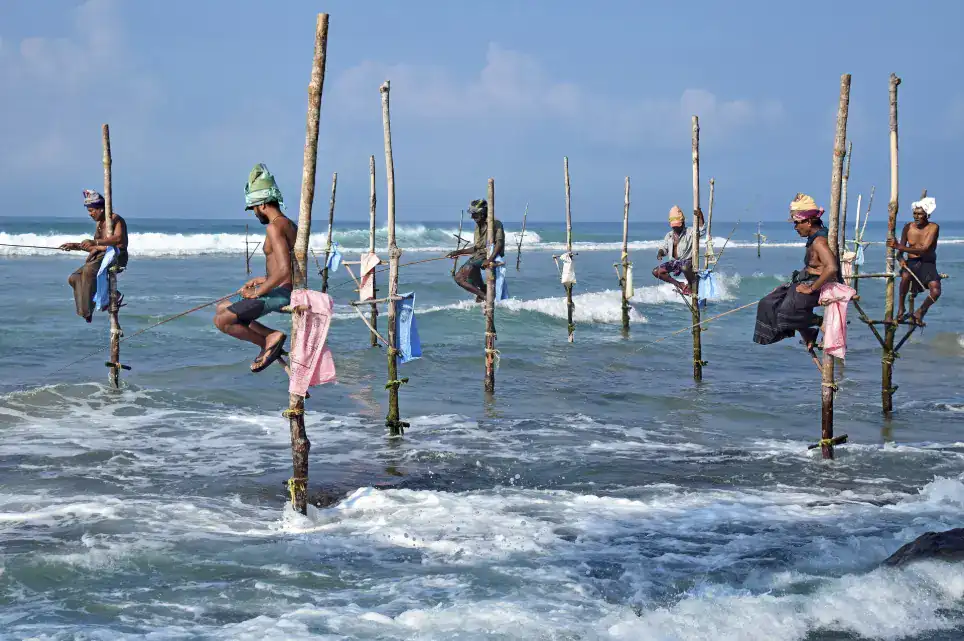
Stilt fishermen sit on a narrow perch above the sea and use a fishing rod to catch small fish. Their wooden structures stand in shallow coastal waters and allow them to fish without a boat.
The traditional fishing method is called Ritipanna (රිටි පන්න) in Sinhala. It is particularly associated with Sri Lanka’s southern coastal region.
The distinctive structure consists of just a few elements:
- Upright wooden pole: This is secured as firmly as possible in the shallow seabed or between suitable rocks.
- Horizontal perch: This provides a narrow seat for the fisherman and is often called a Petta.
- Fishing rod and line: Simple equipment is used to catch small coastal fish.
- Container for the catch: A bag or another container holds the fish that have been caught.
The fisherman climbs the pole, sits on the crosspiece and lowers his line into the water. He must maintain his balance as the waves move beneath him.
This technique requires experience, physical control and knowledge of local sea conditions.
Unlike fishing from a boat, it requires neither an engine nor elaborate equipment. Its success, however, depends heavily on the availability of fish, the surf and a suitable location.
The fishermen’s distinctive posture against the open sea has made Ritipanna an internationally recognised symbol of Sri Lankan coastal culture.
The history of stilt fishing: How did the tradition begin?
The origins of stilt fishing are often traced to the Second World War or the years that followed. According to this widely repeated account, fishermen facing scarce resources and heavily used fishing grounds looked for new ways to fish close to shore.
By placing wooden poles in shallow water, they could reach spots that were difficult to fish from land without needing a boat.
This explanation appears in reports by The National and in regional tourism accounts, among other sources.
Is stilt fishing really centuries old?
The exact age of the tradition has not been conclusively established.
While many travel sources date its origins to the middle of the twentieth century, local families describe a much longer history. For example, an account from a stilt fishing family refers to oral traditions said to go back 150 to 200 years. Older reports also contain differing explanations of how the technique began.
The frequently repeated claim that stilt fishing is thousands of years old is therefore not sufficiently supported.
What can be said with confidence is that the method has been passed down through several generations and forms part of the regional fishing history of Sri Lanka’s south coast.
What role did the 2004 tsunami play?
The tsunami of 26 December 2004 also severely affected Sri Lanka’s southern coastal areas. It damaged coastal infrastructure, disrupted livelihoods and interrupted local fishing activities.
Stilt fishing was affected too. Wooden poles and fishing spots were damaged, while some fishing families had to find other ways to earn a living.
The changes that followed had several causes, however. Alongside the effects of the tsunami, the growth of tourism, changing fishing opportunities and alternative sources of income influenced the continuation of the tradition.
Today, in some stretches of the coast, photography demonstrations can generate more income than fishing itself.
Where can you see stilt fishermen in Sri Lanka?
The best-known places to see stilt fishermen are on Sri Lanka’s south coast, particularly between Koggala and Weligama. This coastal area lies in the Southern Province and is easily accessible from Galle, Unawatuna, Mirissa and other holiday destinations.
1. Koggala: The best-known place for stilt fishermen
Koggala is one of the most famous places to watch and photograph stilt fishermen. Traditional wooden poles stand in shallow seawater along several stretches of beach.
The areas around Koggala Beach and the coastal stretch near Kathaluwa are particularly well known.
If you stop here, be aware that some fishermen only climb onto their stilts when visitors or photographers arrive.
Practical tip: Allow around 15 to 30 minutes for a short visit. If you want to spend longer taking photographs or talking to the people involved, allow a little more time.
2. Ahangama: Tradition along the coastal road
Ahangama lies east of Koggala and is particularly known for its surf spots and relaxed coastal atmosphere.
Here, too, you will find stretches of beach with the stilt fishermen’s characteristic wooden poles.
A visit can easily be combined with a stop at a beach café or a walk.
When travelling along the coastal road, look out for the traditional fishing structures from suitable public access points. Not every pole is occupied, however, and an empty spot does not automatically mean fishermen will appear there later.
3. Weligama: Stilt fishermen and a living fishing culture
Weligama is best known for its wide bay and surfing conditions.
Stilt fishing is also reported in the area around Weligama, including stretches of coast farther west such as Midigama.
If you would like to learn more about the region’s fishing culture, you can also observe everyday life in the coastal towns. The regular work of local fishermen offers a different impression from a stilt fishing scene arranged specifically for visitors.
Comparison: Koggala, Ahangama or Weligama?
| Location | Distinctive feature | Best suited to |
|---|---|---|
| Koggala | Famous scene of wooden poles in the sea | Classic stilt fishing photographs |
| Ahangama | Coastal stretches with fishing and surfing | Combining culture and the beach |
| Weligama and surroundings | Lively coastal town with a regional fishing culture | Longer stays and exploring |
Which location is best? Koggala is the most obvious starting point for the classic photograph. If you are already staying in Ahangama or Weligama, however, you may not need to make a separate, longer journey.
The presence of stilt fishermen cannot be guaranteed at any of these locations on a particular day.
Are Sri Lanka’s stilt fishermen genuine or staged for tourists?
Stilt fishing is a genuine traditional fishing method. However, many of the scenes visible today are arranged for visitors and serve primarily as photographic subjects.
This distinction is one of the most important things for travellers to understand.
For example, a report in the Sri Lankan newspaper The Sunday Times dated 16 February 2025 describes stilt fishermen in Koggala posing specifically for tourists. Some of the poles observed were already so close to the beach that meaningful fishing was no longer possible there.
This does not mean that all stilt fishermen are simply performers.
A report by The National in November 2024 featured a fisherman from Koggala who practised the method in the third generation and actually caught fish.
How can you recognise traditional fishing?
A brief visit to the beach alone cannot provide certain proof. However, several observations can help you assess the situation.
| Feature | Active fishing | Photography demonstration |
|---|---|---|
| Main purpose | Catching fish | Providing photographs for visitors |
| Timing | Depends on fishing conditions | Often on request |
| Fishing activity | Continuous fishing | Sometimes only symbolic |
| Payment | Income from the catch | Agreed photography fee |
| Presence | Depends on local conditions | Often when tourist groups arrive |
The boundaries can be fluid. The same person may genuinely fish and also earn money from photographs.
Is a staged demonstration less authentic?
Not necessarily.
A demonstration can make a traditional skill visible and provide an income for local people. What matters is that visitors understand what they are experiencing and treat those involved fairly.
Problems arise when arranged photographs are presented, without explanation, as spontaneous documentation of an unchanged fishing routine.
Clear captions are therefore helpful for travel journalists, photographers and bloggers.
For example:
“A fisherman demonstrates traditional stilt fishing on Sri Lanka’s south coast.”
This wording describes the technique shown without falsely claiming that an ordinary working day was being documented.
Best time to visit: When can you see the stilt fishermen?
The best time to visit stilt fishermen on Sri Lanka’s south coast is often between December and April. During these months, the southwest and south coasts frequently offer more favourable conditions for beach visits and photography.
This does not mean that the fishermen are active only during these months.
Whether fishing actually takes place depends on factors including the surf, local weather, the availability of fish and activity at the particular location.
Morning or evening: When is a visit worthwhile?
Early morning
Soft light, an often quieter atmosphere and better opportunities to observe natural routines.
Late afternoon
Warm light, beautiful silhouettes and appealing conditions for atmospheric travel photography.
For landscape and travel photographers, the periods shortly after sunrise and before sunset are particularly interesting.
If you are more interested in watching actual fishing, ask locally when the fishermen are usually active. The best time for photography does not necessarily coincide with the best time for catching fish.
Can you see stilt fishermen during the rainy season?
In principle, yes. However, between roughly May and September, the southwest monsoon can bring stronger waves, wind and rainfall to parts of the southwest coast.
Sitting on the wooden poles can become dangerous, particularly in strong surf.
A visit during the rainy season should therefore be planned flexibly. Nobody should be asked to climb onto a stilt for a photograph when sea conditions are unsafe.
How much does it cost to photograph stilt fishermen?
There is no uniform, government-set fee for photographing stilt fishermen.
At some locations popular with tourists around Koggala and Ahangama, payment is expected for photographs or photography demonstrations.
As a rough guide only, local travel reports often mention amounts of around 1,000 to 2,000 Sri Lankan rupees for a basic photo stop. Actual prices can vary considerably depending on the location, number of people, scope of the demonstration and photographs requested.
A Sunday Times report from February 2025 documented different charges, including LKR 1,000 for certain visitor photographs and much higher prices for special sunset shots. These are observed examples, not an official price list.
How to agree a fair photography price
It is best to approach the fisherman or the person in charge politely before taking photographs.
Clarify whether a fee is expected, what the agreed amount includes and whether you may take several photographs.
If you are planning a more elaborate shoot involving specific positioning, a longer session or several people, discuss those arrangements separately.
A polite question in English is usually enough:
“May I take some photos of you? Is there a fee?”
Important: Agreeing a price for a personal souvenir photograph does not automatically give you unlimited commercial use of the image.
Photographing stilt fishermen: Tips for striking and respectful images
Sri Lanka’s stilt fishermen are a fascinating subject for travel and cultural photography. The contrast between the narrow wooden poles, moving water and open horizon allows for a variety of compositions.
Good photography here begins with treating the people in front of the camera respectfully.
1. Take photographs with consent
Ask the person before deliberately photographing them, especially for close-ups and arranged scenes.
Make sure consent is freely given and that the person understands what the images are intended for.
Different legal requirements may apply to public blog posts, journalism, advertising or commercial image publication. Clear consent to the specific use, documented in writing where appropriate, is particularly advisable for commercial projects.
Accept it if someone does not want to be photographed.
2. Use natural light
The light immediately after sunrise and before sunset is excellent for highlighting the fishermen’s outlines and the movement of the sea.
For silhouettes, you can shoot towards the light and expose for the brighter parts of the sky.
If you want faces and details to be visible, soft light from the side works better.
3. Choose the right focal length
Example camera settings
| Type of photograph | Focal length (full frame) | Suggested starting settings |
|---|---|---|
| Landscape with several fishermen | 24 to 35 mm | f/8, 1/250 s |
| Individual fisherman | 70 to 135 mm | f/4 to f/5.6, 1/500 s |
| Fisherman moving a rod | 70 to 200 mm | 1/1000 s |
| Water with motion blur | 24 to 70 mm | 1/4 to 2 s, tripod and ND filter |
These are examples, not fixed rules. ISO and exposure depend on the actual lighting conditions.
A longer focal length can help you fill the frame with the fisherman without getting unnecessarily close.
During long exposures, the fisherman will remain sharp only if he sits as still as possible throughout the shot. The tripod must also be positioned securely without damaging the coastal environment.
4. Aim for a clear composition
Images in which the narrow stilts and fishing rods stand out clearly against the sea can be particularly effective.
Leave enough space around the people and, where possible, avoid awkward overlaps between fishing rods, the horizon and other elements of the image.
A slightly side-on viewpoint often shows the construction of the wooden poles particularly clearly.
Vertical photographs can also be interesting, especially when the slender poles extend across much of the frame.
5. Describe your photographs truthfully
For photography and cultural travel blogs, accurate captions are an essential part of credible reporting.
Identify photographs as demonstrations if the people climbed onto the stilts specifically for your camera.
Avoid inventing claims about individual fishermen’s lives, incomes or traditions.
An informative caption might read:
“Traditional stilt fishing, Ritipanna, near Koggala on Sri Lanka’s south coast. The fishermen sit on narrow wooden poles above the shallow coastal water.”
If the scene was arranged, add that information.
The local perspective: What does stilt fishing mean to the community?
For coastal communities in southern Sri Lanka, stilt fishing offered a way to catch fish and support their livelihoods using relatively simple equipment.
Today, the economic importance of the activity has changed in many places.
Tourism offers additional opportunities to earn an income, for example through photography demonstrations, personal explanations or cultural encounters with visitors.
This development cannot be understood solely as the loss of a tradition. It also shows how people respond to changing economic conditions.
Why do some fishermen no longer climb onto the stilts to fish?
There are several possible reasons: fluctuating catches, physical demands, changing employment opportunities and demand for tourist photographs.
The National’s 2024 report describes the activity both as an inherited fishing method and in the context of income from tourist visits.
Individual fishermen’s motivations differ. It would therefore be wrong to claim that all fishermen have abandoned their original work or now perform only for tourists.
How can travellers support local communities?
A responsible visit recognises that local people decide for themselves whether, and under what conditions, they wish to demonstrate their work.
Fair payment, respectful conversations and an honest portrayal of their work help make these encounters fair.
When the situation allows, a short conversation is often more revealing than a series of dramatic photographs.
For example, you could ask whether the person regularly fishes, how they learned the technique and what it means to their family today.
These questions allow space for personal perspectives without imposing a romanticised idea of traditional fishing life.
Is visiting the stilt fishermen worthwhile?
Yes, especially for travellers interested in photography, coastal culture and traditional practical skills.
However, it is important to visit with realistic expectations.
A photo stop often lasts only 15 to 30 minutes. It therefore makes particular sense as part of a longer journey along the south coast.
An example excursion from Galle to Weligama
Morning: Galle Fort
Start with a walk through the historic fortifications of Galle Fort. The colonial architecture and ramparts provide an interesting contrast to traditional coastal fishing.
Afternoon: Koggala and Ahangama
Travel along the coastal road and stop at a suitable beach access point. Ask about active fishermen or a possible photography demonstration. Allow extra time for conversations.
Late afternoon: Weligama
Relax on Weligama Beach or explore other stretches of coast. If you would like to make the most of particularly attractive light near Koggala, you can instead schedule your stilt fishing stop for the late afternoon.
This combination suits travellers who want to bring together cultural sights, coastal landscapes and photography.
Frequently asked questions about stilt fishermen in Sri Lanka
Where are Sri Lanka’s best-known stilt fishing locations?
The best-known locations are on the south coast around Koggala, Ahangama and Weligama. Koggala is particularly famous for its traditional wooden poles in shallow seawater. The actual number of active fishermen fluctuates, so the locations cannot reliably be ranked by numbers.
What is stilt fishing called in Sinhala?
The fishing method is called Ritipanna (රිටි පන්න) in Sinhala. The term refers to fishing from a perch attached to a wooden pole.
Do stilt fishermen still catch real fish today?
Yes, some fishermen continue to practise the traditional method. At well-known tourist locations, however, many stilt fishing scenes primarily serve as photography demonstrations. Both can occur along the same stretch of coast.
What fish are caught by stilt fishermen?
The traditional method targets smaller coastal fish. Regional reports mention sardines and mackerel-like fish, among others. The actual species depend on the location, habitat and seasonal conditions.
Do you have to pay to photograph stilt fishermen?
There is no general admission fee. However, various tourist locations charge for deliberate photographs and arranged demonstrations. You should therefore ask and explicitly agree a price before taking photographs.
Can visitors sit on a fishing stilt themselves?
Some operators or fishermen allow visitors to try a stilt for a fee. This should only be done with explicit permission, suitable assistance and safe water conditions. The structures are not necessarily designed for inexperienced visitors.
What is the best season for stilt fishing photographs?
December to April often offers favourable weather for beach visits and photography on the south coast. Soft light in the early morning or late afternoon can be especially beautiful. There is no guarantee that fishermen will be present.
Is stilt fishing recognised as UNESCO World Heritage?
Stilt fishing is not listed as a separate UNESCO World Heritage property or as an individual element of UNESCO intangible cultural heritage. Its cultural significance to local coastal communities exists independently of such recognition.
How far is Koggala from Galle?
Koggala is approximately 15 to 20 kilometres southeast of Galle by road, depending on your exact starting point and destination. It is therefore an easily accessible stop on a journey along the south coast.
Conclusion: Experiencing Sri Lanka’s stilt fishermen thoughtfully
Sri Lanka’s stilt fishermen tell an interesting story about traditional coastal fishing, adaptability and the changes brought by tourism.
Their narrow wooden poles in the Indian Ocean are among the island’s most striking sights. Yet behind the familiar photographs are people whose livelihoods and everyday lives have changed over generations.
If you visit the stilt fishermen near Koggala, Ahangama or Weligama, bring more than a camera: a little time, a sincere interest and respect for local people.
Whether you watch an active fisherman or experience an agreed photography demonstration, both encounters can offer valuable insights into coastal culture.
With honest captions, freely given consent and fair payment, a familiar travel photograph can become a respectful encounter with the people of Sri Lanka’s south coast.
Sources and further information
The following publications were among those consulted for the historical context, local perspectives and practical visitor information:
- The National, 22 November 2024: A report on stilt fishing and a fisherman from Koggala.
- The Sunday Times, 16 February 2025: Local reporting on tourist photography demonstrations and fees.
- Explore Sri Lanka: An older report on the fishing tradition and accounts of its history.
- Stilt Fishermen Sri Lanka, History: A local family’s perspective on the history of the fishing method.
Editorial note: Photography fees, the presence of fishermen and local access conditions can change at short notice. The prices mentioned are intended only as a guide. For publication, preferably use your own photographs taken with consent or appropriately licensed images.
Experience the south coast with local flexibility
Stilt fishing is best included as a flexible stop on a private route between Galle, Koggala, Ahangama and Weligama, without a rigid schedule.
Explore private Sri Lanka tours