In this article
Sigiriya Lion Rock in Sri Lanka has approximately 1,200 steps to the summit. The Central Cultural Fund (CCF) gives an ascent time of about 1.5 to 2 hours. Treat this as a guide: fitness, breaks, crowds and weather affect the actual time. Allow additional time for the water gardens, summit, photo stops and descent. Some stairways are steep, particularly the final section above the famous lion paws. High temperatures, long stairways and a fear of heights can make the climb more challenging. The CCF describes the route, approximate step count and ascent time.
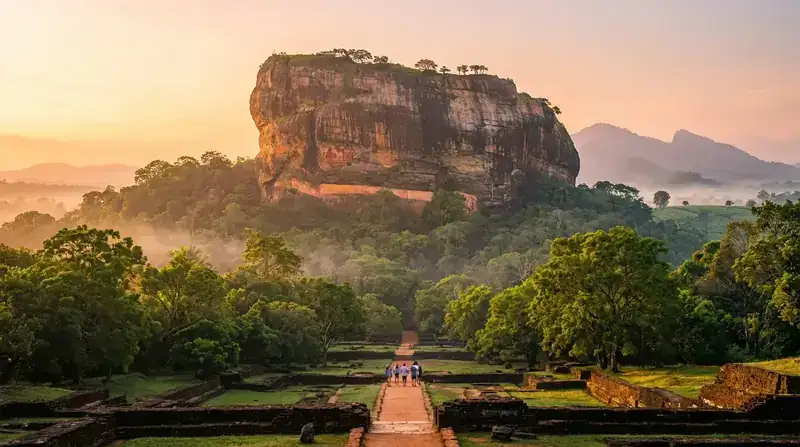
Sigiriya Rock is one of Sri Lanka's best-known attractions. The former royal fortress rises around 180 metres above the surrounding landscape and has been a UNESCO World Heritage Site since 1982.
Before you stand beneath its towering rock faces, a few practical questions are likely to come up: Are 1,200 steps really manageable? Can you take breaks along the way? How demanding is the final section? And is the climb worthwhile with children?
This guide explains what to expect along the route, how to plan your visit and which mistakes to avoid.
Sigiriya Lion Rock: Steps and climb at a glance
- Steps to the summit: approximately 1,200
- Height above the plain: approximately 180 m
- Ascent: 45–90 minutes
- Total visit: 2–3 hours
- Difficulty: Moderate
- Adult ticket: USD 35*
*Standard foreign adult rate according to the Central Cultural Fund, as of September 2026. Prices and visiting conditions may change.
Exactly how many steps does Sigiriya Lion Rock have?
The climb to Sigiriya's summit is usually described as having around 1,200 steps. This is an approximate figure rather than a definitive count of every individual step.
The route consists of several different sections:
- Broad stone stairways between the historic gardens and rocks
- Old stairways and masonry passages
- Metal and spiral staircases near the frescoes
- Steep stairways from the lion paws terrace to the summit
The steps are not evenly distributed. Paths, terraces and viewpoints between the stairways give you opportunities to slow down.
What matters more than the exact number of steps is your ability to climb up and down stairs over an extended period.
Are the 1,200 steps strenuous?
The climb is considered moderately difficult. You do not need technical climbing skills on the normal visitor route.
If you regularly walk, climb stairs and have no significant mobility limitations, Sigiriya is likely to be manageable. The challenge mainly comes from the combination of steps, humidity, heat and occasional waiting times.
The narrower metal staircases can be particularly demanding. You cannot always choose your own pace because other visitors may be immediately ahead of or behind you.
If you have a strong fear of heights, the final section may be challenging. Follow the instructions of site staff and stay on designated paths.
How long does it take to climb Sigiriya Rock?
The Central Cultural Fund gives an ascent time of about 1.5 to 2 hours. Allow a larger time buffer if you take breaks, encounter crowds or are travelling with children. This is a guide, not a guaranteed walking time. Source: Central Cultural Fund (CCF).
A single time estimate cannot cover every visitor. The CCF estimate of 1.5 to 2 hours is for the ascent; allow additional time for the other areas and the descent.
These times are practical planning estimates, not officially measured averages. Visitor numbers, weather and individual circumstances affect the actual duration.
How long does the descent take?
There is no reliable universal time for the descent. Walk at a pace that feels safe and take care on the stairs.
Walk slowly, particularly on smooth stone surfaces and narrow metal steps. Some areas can become more slippery after rain.
How much time should you allow for the whole visit?
Allow additional time for the water gardens, summit and descent. If you want to explore the archaeological museum in detail, add time to your visit.
Climbing Sigiriya: The route step by step
The route to the summit passes through several archaeologically significant areas. Familiarising yourself with the route before your visit helps you manage your energy and notice interesting details along the way.
Stage 1: The water gardens and first ascent
Your route begins among geometrically arranged pools, channels and green spaces. The first rocky sections and stairways follow. This is a good place to ease into the walk and take your first photographs of Lion Rock.
Stage 2: The frescoes and spiral staircase
A steeper flight of stairs brings you to the area of the famous Sigiriya frescoes. These historic paintings are among the site's cultural highlights. Queues can form here when visitor numbers are high.
Stage 3: The Mirror Wall
The route then passes the famous Mirror Wall. Its historic surface and surviving inscriptions show that people have visited this place for many centuries. Do not touch or write on the wall.
Stage 4: The lion paws terrace
The two enormous lion paws mark the historic entrance to the upper fortress. They are a popular photo stop and a sensible place to catch your breath before the final ascent.
Stage 5: The final stairways to the summit
The last section follows steep stairs that run directly alongside the rock face in places. Sure-footedness and a steady pace are especially important here. This part can be more challenging if you have a fear of heights.
Stage 6: The summit plateau and palace ruins
At the summit, you will find historic walls, pools and expansive views across the landscape. Allow at least 20 to 30 minutes to explore the upper area.
The combination of water gardens, frescoes, Mirror Wall, Lion Gate and palace plateau gives Sigiriya its archaeological significance.
How difficult are the final steps on Lion Rock?
For many visitors, the final section above the lion paws is the most demanding part of the climb.
The metal stairways run along the steep rock face. In some places, you have an unobstructed view of the drop below while other visitors are using the route at the same time.
Three things are particularly helpful:
- Focus on the next few steps and follow safety instructions from site staff.
- Give slower visitors enough space and avoid risky overtaking.
- Do not stop in the middle of a narrow staircase to take photographs.
Can you climb Lion Rock if you are afraid of heights?
The climb may be possible with a mild fear of heights. However, the final section may be unsuitable if you have a severe fear of heights or experience panic on exposed stairways.
The prospect of reaching the summit should not push you beyond your own limits.
You can explore historic areas on the lower levels and decide there whether you want to continue.
Are there places to rest along the way?
Yes. Terraces and wider areas between the stairways provide places to stop and rest where the visitor flow allows.
The lower gardens and lion paws terrace are particularly suitable for a short break.
However, do not assume that every rest stop offers shade, seating or drinking water. Bring supplies accordingly.
What is the best time of day to climb?
Early morning is usually the most comfortable time to climb Sigiriya. Temperatures are generally lower than at midday, and the sunlight is well suited to landscape photography.
Visiting times compared
| Time of day | Conditions | Recommendation |
|---|---|---|
| Early morning | Usually cooler, often good light for photography | Particularly recommended |
| Late morning | Increasing heat, possibly more visitors | Manageable with breaks |
| Midday | Stronger sun exposure, limited shade in places | Avoid if possible |
| Late afternoon | Often softer light, but limited time before closing | Good if you allow enough time |
How hot does the Sigiriya climb get?
Sigiriya lies in Sri Lanka's tropical lowlands. Daytime temperatures can rise above 30 °C, while humidity and direct sunlight make the exertion feel more intense.
The water gardens offer vegetation and shade in places. However, many upper stairways and parts of the summit are exposed to the sun.
Try to complete as much of the ascent as possible during the cooler morning hours.
Which season is best?
Sigiriya can generally be visited throughout the year. However, weather and rainfall vary by month.
Weather conditions vary with the time of year. Before your visit, check the local forecast and current official access notices.
Weather and access conditions can change at short notice. Follow current official advice and instructions on site.
Sigiriya entrance fees in 2026: How much does Lion Rock cost?
Visiting Sigiriya Rock is relatively expensive for international tourists. However, the standard admission ticket includes the archaeological museum as well as the rock complex.
The government-run Central Cultural Fund's price list published in September 2026 gives the following rates:
| Ticket category | Admission price |
|---|---|
| Foreign adults, standard rate | USD 35 |
| Foreign children, reduced rate | USD 20 |
| Sigiriya Museum only | USD 6 |
As of September 2026, according to the official CCF price list. Under the CCF ticket conditions, the reduced foreign child rate applies to children aged 6 to 12. Other nationality and eligibility categories may have different rates.
The local currency is the Sri Lankan rupee (LKR). If you pay in rupees, the amount depends on the exchange rate used for ticket payments.
Official sources for prices and tickets:
Where can you buy Sigiriya tickets?
Tickets can be purchased at the official ticket counter or through the Central Cultural Fund's e-ticket service.
Note that the government booking portal provides for placing an order and then collecting the ticket at the counter. Keep your booking confirmation ready.
You do not need an additional tour operator for a normal visit. Guided visits are optional.
What are Lion Rock's opening hours?
Published opening hours currently differ. The Central Cultural Fund lists 07:00 to 17:00 on one ticket page, while Sri Lanka's Department of Archaeology gives 06:30 to 17:30. Other visitor websites publish longer opening hours.
These differing details do not establish a single, reliably confirmed current opening time.
Check the current entry and ticket-counter closing times directly with the Central Cultural Fund the day before your visit. This is especially important if you want to climb at sunrise or late in the afternoon.
Sigiriya with children: Is the climb suitable for families?
Lion Rock can also be an impressive experience for children. They need to be able to manage longer flights of stairs independently and cope with narrower, elevated paths.
A blanket age limit for the climb would not be particularly helpful, as stamina and sure-footedness differ from child to child.
Can children manage the 1,200 steps?
Many active school-age children can manage the climb in suitable conditions. Plan especially carefully with younger children.
Keep these points in mind:
- There is no continuous pushchair-accessible route to the summit.
- Children need particularly close supervision in narrow sections of the upper stairways.
- Tropical heat can tire children more quickly.
- Frequent drinking breaks are sensible.
- Carrying an exhausted child on steep metal stairs can be risky.
Families should allow three to four hours for the whole visit instead of climbing under time pressure.
Is Sigiriya suitable for older visitors?
Age alone does not determine whether the climb is possible.
Balance, stamina, the ability of your knees to cope and the capacity to climb repeated steep stairways matter more.
People with limited mobility, serious joint problems or relevant cardiovascular conditions should decide individually whether to attempt the full ascent, seeking medical advice where appropriate.
You can still experience the gardens and parts of the archaeological site without reaching the summit.
What should you bring for the 1,200 steps?
Packing list for the Sigiriya climb
- At least 1 to 1.5 litres of drinking water per person as a planning guideline, with more if needed in hot weather
- Comfortable shoes with good grip
- Light, breathable clothing
- Sunscreen, sunglasses and a hat
- A small backpack to keep your hands free
- A phone or camera with sufficient battery charge
- Your ticket, booking confirmation and identification if required
- A small towel and personal medication
Avoid heavy luggage. The less weight you carry on your back, the more comfortable the many stairways will feel.
Can you take photographs at Lion Rock?
You can take photographs in many publicly accessible areas of the site. However, restrictions apply at the historic Sigiriya frescoes, where photography and filming are prohibited.
Follow signs and staff instructions. Drones and commercial photography may require special permission.
The best photo spots on the way to Sigiriya's summit
Sigiriya is one of Sri Lanka's most striking photographic subjects. With a little planning, a single visit can offer very different perspectives.
1. Water gardens: The classic overall view
The rock fortress looks especially monumental from the lower gardens. Use the symmetrical pools and paths as foreground elements and position the rock near the centre of your frame.
2. Lion paws: The historic landmark
Here you can see why Sigiriya is called Lion Rock. The enormous paws are the surviving part of a once much larger Lion Gate. Including people in the photograph can help convey their scale.
3. Summit plateau: Panoramas and history
Photograph the walls of the historic palace complex together with the green plains. A wide-angle lens is particularly useful for capturing the scale of the summit site.
4. Pidurangala: An outside view of Sigiriya
If you want to photograph the whole of Lion Rock from a distance, neighbouring Pidurangala Rock is a well-known alternative. This viewpoint is not on the Sigiriya ascent route and requires a separate visit.
For softer light, choose the earlier or later part of the day. Whether you can photograph particular scenes at sunrise or sunset depends on the actual opening hours and weather conditions.
Sigiriya or Pidurangala: Which climb is more worthwhile?
Pidurangala Rock stands near Lion Rock. Both can be climbed, but they differ considerably.
Sigiriya Lion Rock
Historic palace complex reached by stairways
Pidurangala Rock
Nature trail with a scrambling section and views of Sigiriya
| Feature | Sigiriya Lion Rock | Pidurangala Rock |
|---|---|---|
| Route | Mostly stairways | Nature trail, rock steps and scrambling |
| Difficulty | Moderate | Moderate, with a more demanding final section |
| Time needed | Around 2–3 hours in total | Around 1.5–2.5 hours in total |
| Main attraction | UNESCO fortress, frescoes and gardens | Panoramic views of Sigiriya |
| Admission | USD 35 for standard foreign adult tickets | Separate, substantially cheaper ticket |
| Suitable for | Visitors interested in culture who are steady on their feet | Agile, sure-footed walkers |
These times are guidelines. Actual conditions may vary with weather, visitor numbers and individual fitness.
Which rock is easier to climb?
For many visitors, Sigiriya is more predictable because most of the route consists of constructed stairways.
At Pidurangala, by contrast, you need to negotiate larger boulders near the top. This section can be more difficult than Sigiriya's steps, especially when wet or if your mobility is limited.
Choose Sigiriya if you want archaeological sights and history. Pidurangala offers the right perspective for a panorama of the famous Lion Rock.
If you have enough time and stamina, you can visit both rocks in one day, but try not to combine the activities during the strongest midday heat.
Getting to Lion Rock: Where is Sigiriya?
Sigiriya is in Sri Lanka's Central Province, in Matale District, near the town of Dambulla. The rock fortress forms part of the Cultural Triangle of Sri Lanka.
How do you get from Dambulla to Sigiriya?
Dambulla is a practical starting point for a day trip. The road distance is approximately 20 kilometres, depending on your exact starting point.
You can travel by tuk-tuk, taxi or hire car, or combine public transport with a local transfer.
If you want to reach the rock early, consider staying overnight in Sigiriya. This can substantially shorten your journey on the morning of your visit.
Should you book a guided tour?
A guide is not compulsory. You can generally explore the normal visitor route independently, provided it is open and you follow the signs.
However, a knowledgeable guide can explain the history of King Kassapa, the architecture of the water gardens and the significance of the frescoes in more detail.
For a private guided visit, agree on the price and included services beforehand.
For your onward travel plans, our 10-day Sri Lanka itinerary with a private driver offers a suitable route. If you would like to combine culture with wildlife watching, also read our guide to a safari in Minneriya National Park.
Seven common mistakes when climbing Sigiriya
- Starting too late in the day. In the midday heat, 1,200 steps can feel considerably harder. Start as early as possible.
- Bringing too little water. Do not rely on being able to buy drinks along the route.
- Wearing unsuitable shoes. Slippery sandals or smooth soles increase the risk on metal and stone stairs.
- Underestimating the final section. There are still demanding stairways between the lion paws terrace and the summit.
- Skipping the water gardens. They are an essential part of the historic site's overall design and offer excellent photographic perspectives.
- Allowing too little time for the descent. Tiredness and high steps can make the return journey slower than expected.
- Failing to check ticket prices and opening hours. Especially early or late visits should be planned using current official information.
Frequently asked questions about Sigiriya Lion Rock's steps
How many steps do you need to climb to reach Lion Rock's summit?
There are approximately 1,200 steps to the summit of Sigiriya Lion Rock. The route includes old stone and brick stairways as well as more modern metal stairs along the rock face.
How long does it take to climb Sigiriya's 1,200 steps?
The Central Cultural Fund gives an ascent time of about 1.5 to 2 hours. This is a guide; fitness, breaks, crowds and weather affect the actual time. Allow additional time for the summit, descent and water gardens.
Do you need to be athletic to climb Sigiriya?
No special athletic skills are required. However, a reasonable level of fitness, sure-footedness and the ability to manage longer flights of stairs are important.
Is the climb dangerous?
The route includes steep stairways. Follow current safety instructions from site staff and stay on designated paths.
Can you climb Lion Rock without a guide?
Yes. Visitors can explore the signposted route independently. A guide is optional and particularly helpful if you want to learn more about history, architecture and archaeology.
Can you take a pushchair up Sigiriya?
No. Reaching the summit involves numerous stairs and narrow passages. A pushchair is not suitable for the ascent.
Is there a lift up Lion Rock?
No. There is no lift for the regular summit ascent. Visitors must negotiate the stairs and connecting paths on foot.
Can you turn back along the way?
If you decide not to continue to the summit, ask site staff how to return. Route arrangements may be managed on site, so follow current instructions.
Can you climb Lion Rock in the rain?
Access and weather conditions can change at short notice. Check current CCF notices before your visit and follow instructions on site.
Is Sigiriya worthwhile if you do not reach the summit?
Yes, particularly if you are interested in history. The water gardens, historic landscaping and views of the massive rock already make for an impressive visit. However, the summit ruins and some of the best-known views remain inaccessible without completing the climb.
Conclusion: Are Sigiriya Lion Rock's 1,200 steps manageable?
The roughly 1,200 steps on Sri Lanka's Lion Rock are manageable for many travellers with a reasonable level of fitness. A suitable pace, enough water, good footwear and a sensible choice of visiting time are key.
The CCF guide for the ascent is about 1.5 to 2 hours. Allow more time for the summit, descent and water gardens; total visit time depends on pace, crowds and breaks. Build in extra time if you are travelling with children, need frequent breaks or want to explore the archaeological site in detail.
Sigiriya rewards the effort with sweeping views, monumental lion paws and the remains of an extraordinary fifth-century royal complex.
The most useful tip: do not treat the climb as a race. Start early if possible, take breaks in suitable places and give yourself time to discover the historic details along the way.
Sources and further information
The information about history, height, step count, the visitor route and admission prices is based on the following sources. Ticket details were checked against the price list published in September 2026.
- UNESCO World Heritage Centre: Ancient City of Sigiriya. Official information about the World Heritage Site, fortress and historical context.
- Central Cultural Fund Sri Lanka: Sigiriya Rock Fortress. Information about the heritage site and ascent.
- Central Cultural Fund: Official ticket price list. Admission prices, most recently listed in September 2026.
- Department of Archaeology Sri Lanka: Sigiriya. Information about the attraction.
- Sri Lanka Tourism: Sigiriya and Sri Lanka's heritage. Historical background and visitor information.
Editorial information as of 27 October 2026. Climbing times are planning estimates, not guaranteed walking times. Prices, opening hours and access restrictions may change.
Plan a relaxed visit to Sigiriya
We plan your visit with a suitable overnight stay, a private driver and enough time for the climb.
Request a personalised itinerary